Tuesday, October 29, 2013

Deformity in Disney

    
      Throughout the majority of The Hunchback of Notre Dame (1996), Quasimodo's only friends are three gargoyles that come to life when Quasimodo is alone. In his article "'You're a Surprise from Every Angle': Disability, Identity, and Otherness in The Hunchback of Notre Dame," Martin Norden points out that "the gargoyles' explicit and implied messages are troubling, to say the least, and go a long way toward undercutting whatever sympathies the filmmakers had created for its disabled character" (168). After reading this, I decided to go back to the film and watch the gargoyles' song "A Guy Like You" once more. 
      When the song ended, I was amazed to realize that Norden is right. Although I had never paid much attention to it before, when describing how Esmerelda could possibly be in love with someone like Quasimodo, the gargoyles consistently reference Quasimodo's physical appearance. If the film was truly meant to represent deformity in an accepting light, the gargoyles should have been talking about Quasimodo's character and how he is a kindhearted person that Esmerelda would be lucky to have. Instead, they sing about how Quasi is shaped like a croissant and how it's hard to forget a face like his. 
      One of Victor's lyrics struck me in particular, when he sings about how Quasi deserves "extra credit because it's true you've [Quasi] got a certain something more". Normally, this statement wouldn't bother me. However, the way Victor delivers this lyric is troubling. In the song, the gargoyle slows down when singing the words "certain something more," implying that the "certain something more" that Quasi has is his deformed physical appearance. This throws this originally harmless lyric into an entirely new light. Now this line seems to promote the idea that the physically disabled deserve special treatment, which completely undermines the supposed message of the movie that all people should be treated equally.           While it is understandable that characters such as Frollo and the villagers would focus mostly on Quasimodo's looks rather than his character for the majority of the film, it is ridiculous that Quasi's friends, who have probably known him for quite some time, are still unable to see past his outer layer. If Disney were truly attempting to encourage acceptance of those who are deformed, it should not have had the gargoyles focus so intently on that aspect of Quasi's character. 

Monday, October 21, 2013

The Alpha Male

     One of my favorite articles that we have read so far in this class is Ken Gillam's article titled, "Post-Princess Models of Gender: The New Man in Disney/Pixar." In this article, Gillam argues that Pixar promotes a more feminine model of masculinity rather than the traditional alpha male. Using Lightning McQueen from Cars, Mr. Incredible from The Incredibles, and Woody and Buzz Lightyear from Toy Story as evidence, Gillam does a fantastic job of showing that these three films promote a less macho version of masculinity. 
     This article reminded me of my brother a lot. Over the last few years, my brother has struggled with the idea of masculinity as he faced graduating from college and entering the real world. He has been diagnosed with having anxiety and obsessive compulsive disorder. My brother's form of obsessive compulsion comes in the form of obsessive thoughts, and one of these thoughts that he has had some trouble shaking over the last couple of years is this idea of being an alpha male. My brother obsesses about typical things such as being able to provide for his family, however he also focuses on trying not to show emotions and physique. There have been many times where my brother will become depressed because he believes he is not the tall, muscular man of most films. Although I attempt to reassure him that nothing is wrong with him or his body, he is unable to shake these thoughts and they continue to plague him. 
    Often times, too much of Disney's criticisms focus on the company's portrayal of women in its animated films. Although there is still room for improvement, Disney has come a long way when it comes to female stereotypes when one considers the differences between Snow White and Rapunzel. Now it is time to focus on Disney's men. The typical depiction of Disney princes are men with lean bodies and immense courage and strength. They show no fear in the face of danger and they are always there to protect their female counterparts. This portrayal is unrealistic and boys need to be shown that it is okay to let a woman take care of them occasionally and that emotions should not be suppressed or avoided. The media affects men as well as women, and we need to start recognizing this and working towards more accurate depictions of both male and female roles.

Live-Action Reference Footage

     During Fall Break, one of the first things that I did was I went to Best Buy with my dad to pick up the Diamond Edition of The Little Mermaid. My dad was just as excited as I was to watch the hours of special features that were part of this addition as well as to see the movie in 3D for the first time! As much as I loved watching my favorite movie with an added dimension, my favorite part of this new edition of The Little Mermaid was getting a behind-the-scenes look at the live-action reference footage that was used in The Little Mermaid as well as in Disney films across the decades.
     For those of you who don't know, live-action reference footage is what Disney animators use to ensure that their animations of both people and animals are realistic. For The Little Mermaid, the company hired actors to play Ariel, Prince Eric, and the remainder of the human cast. These actors would then go through every scene that involved these characters and act them out in front of gridlines and from various angles. This gave the Disney animators footage of realistic human movement that they could reference while drawing the movie. According to the special features, this live-action reference footage came in handy the most when the animators were attempting to draw one of the final moments in "Part of Your World" when Ariel reaches through the opening in the top of her grotto. Without this footage, the animators wouldn't have known where to draw Ariel's hand in relation to the opening as well as how much larger Ariel's hand should get as the frames progressed.
     I enjoyed seeing this aspect of Disney animation as I had never thought about how the animated movies were blocked (how the characters' movements were decided on) before. This special feature showed me once again the enormous amount of effort that goes into creating the animated movies that I love so dearly.

Wednesday, September 25, 2013

The Creation of Flynn Rider

The day that Tangled (2010) came out on DVD, I went to Best Buy, picked up a copy, and immediately went home to watch the bonus features. One of the most interesting parts of this behind-the-scenes look at Tangled was seeing how much effort the animators put into creating Flynn Rider's appearance. I don't know if this is just me, but I never think about the fact that someone had to pick every little feature of a character's image, from the way his hair falls to the color of his shirt. In this special feature, the movie's directors Nathan Greno and Byron Howard talk about the process that they went through to finalize the appearance of Flynn Rider. Basically, the taped pictures of Hollywood's most attractive stars around a room and then called in female employees that worked in the animation building. The job of these females was to tell the animators what features they liked and didn't like about each star. Then, the animators came up with hundreds of potential drawings depicting Flynn Rider. In some he looked like a bodybuilder with long hair, while in others he was rather scrawny. These animators had thought of almost every possible combination of handsome features for a male character. Then, they brought the female employees back to analyze the drawings. Using the input from these women, the animators finally created a character that had warm, brown eyes to match his brunette hair (which, according to the women, made him seem less egotistical), was toned but not too muscular, and had a little bit of facial hair to give him a slight edge. I loved watching this clip because I had never thought about the intense process that goes into designing every single character in an animated movie, and now every time I watch animated movies I think about how different the movie would feel if one character had looked different.

Disney v. Andersen

     Despite The Little Mermaid's enormous popularity, the film has also received an incredible amount of criticism since its release in 1989. In her article, "The Little Mermaid," Roberta Trites argues that Disney's adaptation of Hans Christian Andersen's tale of the same name takes away the integrity of every female character, teaching women that they should always be dependent on men. While I agree that many of the original tales morals were altered to fit the Disney "formula," critics should recognize the necessity of these changes and the strengths of this movie rather than simply focusing on its faults. 
     For those of you who aren't familiar with Andersen's tale, here are some of the major changes Disney made in its adaptation. First of all, in the original tale, the sea witch is not looking for revenge. Therefore, Ariel seeks her out to transform into a human. Secondly, when Ariel is transformed into a human it is an incredibly painful process that makes her feel as though she is walking on knives for the rest of her life. In addition, Ariel doesn't get her happy ending. The prince marries another woman and Ariel dissolves into sea foam before becoming a daughter of the air where she then spends her afterlife attempting to gain an immortal soul through doing good deeds. Lastly, and probably the most important difference, merpeople do not have immortal souls in Andersen's tale. Although she is also motivated by love for the prince, part of Ariel's determination to marry the prince is to gain an immortal soul. However, in the Disney movie, all she wants is to marry the handsome prince. 
     So yes, Ariel's motives seem much more shallow in the Disney adaptation than they do in Andersen's tale. Let's face it though, Andersen's tale would not have made a great animated children's movie. If I were watching that movie when I were five years old, I would have been terrified and my parents would have been horrified that they had let me watch it. For the sake of marketability, Disney had to drastically alter the original tale and therefore some of the original morals. If they hadn't, The Little Mermaid would not have been nearly as successful and Disney would have lost a huge amount of money producing that movie. And although some may argue that Disney should have simply avoided adapting Andersen's tale at all, I believe that Disney would have been stupid to ignore this tale. Many people dream of what lies at the ocean floor. This makes the ocean the perfect setting for an animated movie, because the animators are free to create an entirely new world. Part of The Little Mermaid's genius is that it translated a human world into an unknown, seemingly magical setting. So although Disney drastically altered the values behind Andersen's tale, The Little Mermaid was still an incredible feat in the world of animated films and it should still be recognized for its strengths while being criticized for its weaknesses. 

Sunday, September 22, 2013

Disney Eye Makeup

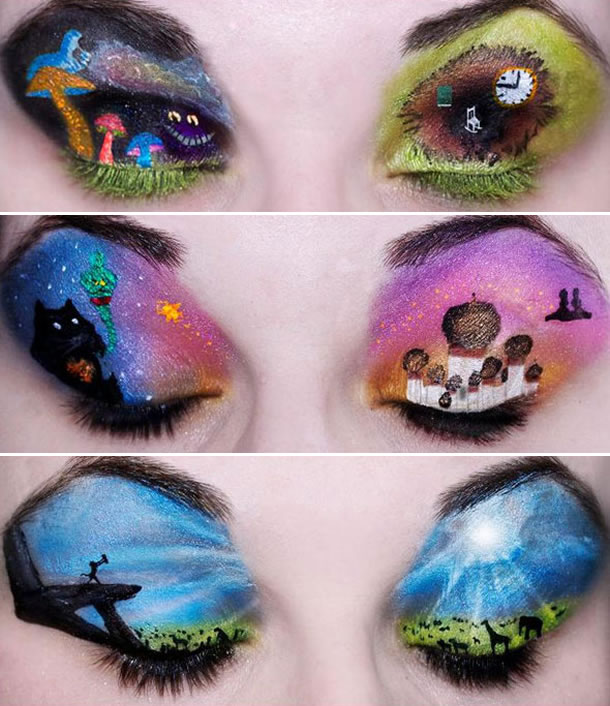
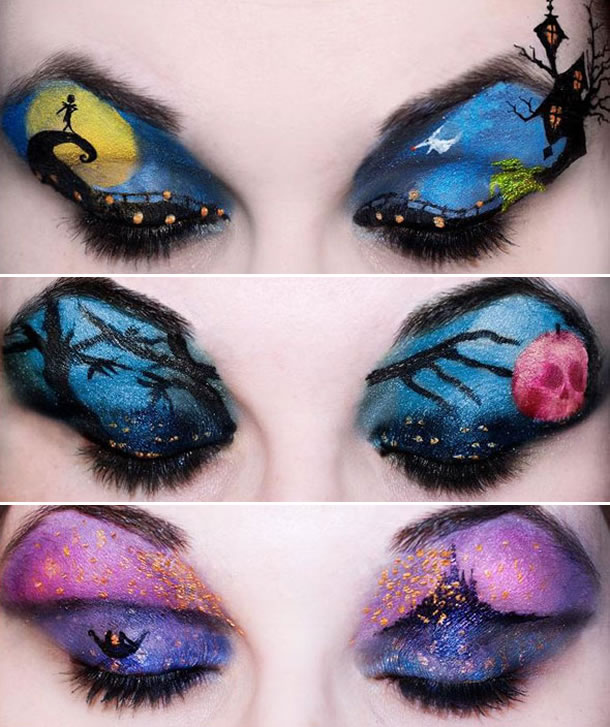
I remember on Pinterest last year I was scrolling through my 'Popular' feed and these pictures of beautifully done eye shadow came up. When I clicked on them, I realized they were actually depictions of scenes from popular Disney movies...drawn on people's eyelids. I was blown away by the artistry of whoever managed this feat and I wanted to share these pictures with all of you, which can be found on Google by searching "Disney Eye Makeup."
Alice in Wonderland, Aladdin, and The Lion King
The Nightmare Before Christmas, Snow White, and Tangled

The Village Idiot

In my Disney writing course, we recently had to read an article entitled "Dopey's Legacy: Stereotypical Portrayals of Intellectual Disability in the Classic Animated Films" by Karen Schwartz, Zana Marie Lutfiyya, and Nancy Hansen. The authors argue that characters such as Dopey from Snow White, Gus from Cinderella, and Lefou from Beauty and the Beast perpetuate negative prejudices against mentally challenged individuals. While these women do make some valid points along the way, there were many moments while reading this article where I couldn't help but laugh. The most ridiculous part of this article was when they began to discuss Lefou's role in Beauty and the Beast. Fou in French means fool, which is certainly an accurate description of Lefou's character. However, just because he is typecast as the village idiot doesn't mean that Disney is implying that he is mentally challenged. At one point, Schwartz, Lutfiyya, and Hansen go so far as to argue that when Lefou's mouth is filled with leaves after being hit by a branch, Disney is implying that Lefou has nothing relevant or worthwhile to say. That moment is simply meant to be comic relief in an animated movie! I admit that throughout the movie Disney repeatedly implies that Lefou is less of a man than Gaston and that he is not the brightest man around, but I don't believe that Disney meant anything harmful by this. Lefou is simply meant to be an entertainingly silly character and a subtle reference to the days of slapstick comedy.